Blog
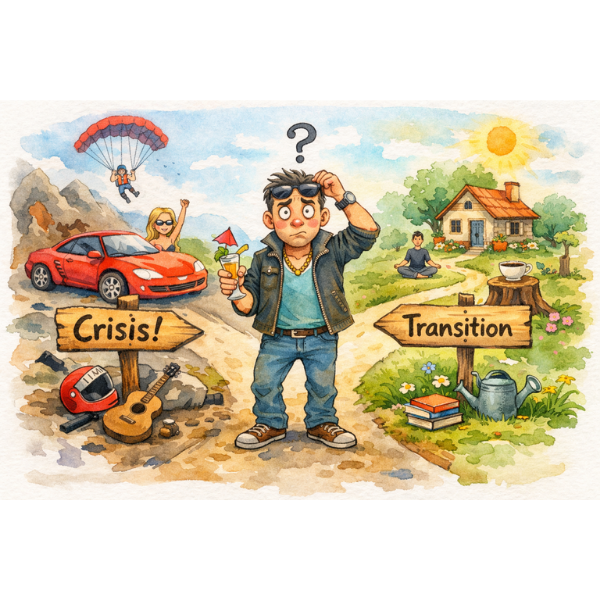
For many people, the phrase midlife crisis still evokes images of chaos: reckless decisions, sudden changes, impulsive behavior.
In reality, what most people experience is not a breakdown — it’s a transition.
And transitions require clarity, not panic.
Why midlife feels destabilizing
Midlife is often the first moment when earlier life strategies stop working.
The things that once provided structure — career momentum, relationships, routine — begin to feel misaligned.
This creates discomfort, not because something is “wrong,” but because the internal context has changed.
What used to be sufficient no longer is.
The problem with how we talk about midlife crisis
Most popular narratives frame midlife crisis as something to fix or escape.
This leads to two unhelpful responses:
- suppressing the discomfort and pretending nothing is happening
- reacting impulsively, hoping intensity will replace meaning
Neither addresses the real issue.
A midlife crisis is rarely about wanting more.
It’s about realizing that less no longer works.
Midlife as an information point
Instead of treating midlife crisis as failure, it’s more accurate to see it as information.
Information about:
- misaligned priorities
- outdated roles
- habits that outlived their usefulness
- relationships that function by inertia
This information doesn’t demand immediate action.
It demands interpretation.
Why clarity matters more than change
Many people rush to change their external circumstances before understanding their internal position.
They quit, move, reinvent — and end up recreating the same dissatisfaction in a new form.
Clarity works differently.
Clarity asks:
What exactly stopped working?
When did I start tolerating it?
What am I maintaining out of habit, not choice?
Without these answers, change is noise.
Midlife transition vs. midlife collapse
A transition is deliberate.
A collapse is reactive.
The difference is not personality — it’s attention.
People who slow down, observe their own mechanisms, and resist immediate solutions tend to navigate midlife with far less damage — to themselves and to others.
You don’t need a solution. You need a framework.
Midlife is not a call to become someone else.
It’s an invitation to stop performing outdated versions of yourself.
Not everything has to be rebuilt.
Some things only need to be released.
Final thought
A midlife crisis is not chaos.
It’s a signal.
If you treat it as information instead of an emergency, it becomes one of the most clarifying phases of adult life.
Not all unhealthy habits are dramatic.
Some don’t ruin your health or your finances. They simply consume time — quietly, persistently — until you wonder where your days went.
Midlife is often the moment when this becomes visible.
The problem is not that these habits are “bad.”
The problem is that they outlive their function.

Habit 1: Endless background noise
Scrolling, podcasts you don’t listen to, TV playing “just in case.”
Noise feels comforting, but it fragments attention and extends tasks that could be finished in half the time.
Unlearning:
Designate silence as a default, not a reward.
Choose noise intentionally — not as background anesthesia.
Habit 2: Reactive communication
Instant replies. Constant checking. The illusion of availability.
You’re busy, but rarely moving forward.
Unlearning:
Batch communication.
Decide when you are reachable — instead of proving it all day long.
Habit 3: Emotional caretaking without limits
Listening, advising, absorbing other people’s problems — often without mutual benefits.
This drains time and energy under the banner of “being there.”
Unlearning:
Stop offering emotional labor by default.
Wait to be asked. Notice who returns the favor.
Habit 4: Perfection-as-delay
Overpreparing. Refining endlessly. Waiting until things feel “ready.”
It feels productive. It mostly postpones decisions.
Unlearning:
Lower the threshold of “acceptable.”
Finish more. Polish less. Better done than hanging in the air.
Habit 5: Automatic routines that no longer fit
Same schedule. Same obligations. Same patterns — even when circumstances changed years ago.
What once stabilized you now simply fills the calendar.
Unlearning:
Audit routines annually.
Ask one blunt question: If this started today, would I agree to it?
What You Gain Back
Unlearning isn’t about discipline.
It’s about recovering time already spent on autopilot.
Not for productivity.
For thinking. For rest. For deliberate choices.
Time doesn’t disappear.
It leaks through habits that were never questioned.
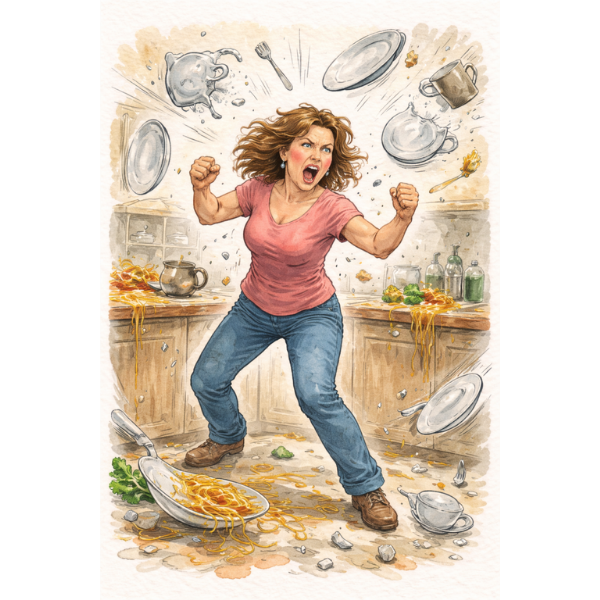
If you suppress your own needs for years, it’s no surprise they eventually erupt — often suddenly, often destructively. Lives don’t fall apart overnight. They fracture slowly, through prolonged self-neglect.
At some point, you may realize you’re tired of being the comforting ear for everyone else’s problems. Yours were never treated with the same seriousness. And one day, that imbalance stops being tolerable.
That’s usually when boundaries become necessary.
Start by being precise with yourself. Ask what you actually expect from relationships — any kind of relationship. Do you feel consistently pushed aside? Are your concerns minimized, while someone else’s minor inconvenience, like a broken nail, becomes the centerpiece of a two-hour conversation?
Tick, tock. Time passes either way.
Set boundaries early whenever possible. Repairing patterns after thirty years is far harder than after three weeks. Be explicit about what you do not accept. Repeatedly ignoring unacceptable behavior is usually interpreted as consent.
If something hurts you, you don’t owe tolerance.
You owe clarity.
Stand up for yourself — no one else will do it for you. Do it without aggression. No theatrics, no insults. Just calm firmness. A clear “no” directed at specific behavior.
Intrusive questions? Boundaries apply there too.
If someone insists with phrases like “You can tell me” or “If you started, you have to finish”, they are not being supportive — they are disregarding your autonomy. And that alone answers the question of how much access they deserve to your private life.
Boundaries are not hostility.
They are maintenance.
Set them — or one day you’ll explode. And that explosion will come as a surprise not only to others, but to you as well.
Even if you truly don’t care what others think, drops still wear away stone.
Skeptical comments, spiteful remarks, or “well-meaning” questions can quietly drain your momentum — especially at the beginning.
Maybe you’ve just enrolled in studies you’ve been postponing for years.
Maybe, as part of a midlife crisis, you’ve started learning a new language.
Or perhaps you’re taking up a new, completely harmless hobby.
The problem is that so-called nay-sayers can drain your energy faster than real difficulties ever will. And once that starts, gossip begins to circulate — in which what you’re actually doing makes up perhaps one-tenth of the story.
How do you prevent that?

First, talk about your new undertaking only with the people closest to you.
For example, with a partner who might wonder where you disappear for several hours or what you’re so intensely focused on with your laptop. If a budget is involved, it’s also worth being clear about that with your spouse.
If you’re in a casual relationship, you don’t have to explain everything.
Parents and friends don’t need to know it all either.
This helps you avoid gossip and stay focused on the project itself, rather than the sudden commotion around your person.
Once you finish your studies or bring a time-consuming project to completion, then you can share the news. And if someone asks, “Why didn’t you say anything earlier?” a standard response will do:
“I didn’t know if I’d make it to the end.”
Paradoxically, it’s much easier to persevere with internal motivation than in an atmosphere of other people’s irony and sarcasm.
And the satisfaction is often greater when you see their surprise at the end, instead of enduring commentary along the way.
Ultimately, you know what’s good for you and what’s a waste of your time.
So don’t allow other people to comment on decisions that don’t belong to them.
Pause.
Before you act on the urge — ask yourself a few basic questions:
Is it legal?
Is it safe for you, for other people, for animals, for the environment?
Is it reversible?
Is it ethical?
Will you regret it?
If you can answer these honestly — and the craving for intensity is still there —
then it may be worth approaching it differently.
This short booklet is not an invitation to recklessness.
It’s an attempt to understand where the need for adrenaline comes from — and how to engage it without unnecessary damage.

Adrenaline Junkie Prison
How to Survive in the Office
This is not a book about productivity.
And it’s not about learning to love routine.
It’s about understanding why some people experience office life not as stability, but as confinement — and what to do with that knowledge.
If you feel chronically restless, bored to the point of irritation, or oddly alive only in moments of pressure, risk, or urgency, this isn’t a character flaw. It’s a wiring issue. Routine doesn’t calm you. It drains you.
This book looks at what happens when thrill-seeking personalities are placed in environments designed for predictability.
This is not a book meant to calm you down or lead you.
It’s more an invitation to pause and look closely at your own mechanisms — without haste and without pressure to change.
It reads best alongside a moment of transition, not as an answer, but as a background for thinking.
You can find the book HERE