Blog
This is the first article in the life audit series. It concerns situations that were meant to be temporary but, through repetition, became our second nature.
“I’ll just work a bit longer today” turns into years spent in front of a laptop, with chronic back pain as a bonus.
“I’ll smoke just one cigarette” becomes a long-term and harmful addiction.
“I’ll stay here only until I find a better job” — and suddenly twenty years have passed, and you are still there.
It is worth creating a list of situations that were meant to be temporary but quietly became a form of imprisonment. Sometimes it is a relationship — not necessarily romantic. Perhaps you became accustomed to a toxic acquaintance, and they to you, and the years moved on.
There are also positive versions of this trap. A few casual dates might unexpectedly lead to compatibility and a family. A temporary experiment may turn into a meaningful hobby.
But what about the situations that do not serve you? Perhaps watching a series “just to relax” has become a compulsive routine used to suppress anxiety about the future.
I will not tell you what to do. It is, however, worth examining these situations carefully. Look at them from the perspective of your younger self — what would that version of you have said? Now let the clock jump twenty years forward. Your older self is observing your present choices.
Do you still want it to look like this?
Traps are difficult to escape.
Create your own escape plan from a situation that doesn’t serve you. Don’t start with radical moves. As my friend says, sometimes it was simply meant to be.
However, if a situation objectively does not serve you, you — the person who knows best your own potential and capabilities — should analyze and reflect carefully. Perhaps it is worth stopping being a prisoner of temporariness.
Many people affected by a midlife crisis (which is supposedly a myth, but for a myth it is remarkably persistent and uncomfortable) decide to introduce a series of changes into their lives.
This often includes changing their job.
Is that a good move?
Let’s look at the pros and cons.
Cons
First, you usually have to start climbing the hierarchy all over again and accept a lower salary. This may result in reduced income and a less comfortable lifestyle.
Second, the change may turn out to be misguided. You might believe a certain profession is perfect for you — for example after watching a Netflix series — only to discover in practice that it is tedious and boring, while what you actually crave is adrenaline.
Third, social ostracism. Society tends to believe that once you enter a professional role, you should stick with it until retirement. There may be misunderstanding, raised eyebrows, half-smiles.
Fourth, how do you explain it to a new employer? A midlife crisis — and the word crisis itself — sounds alarming. It carries associations of instability, distraction, and lack of focus.
Fifth, you may fail. You leave a well-paid job for an idealistically chosen profession and, after a two-week trial period, you are dismissed — perhaps simply because of a generational gap between you and a much younger team. Checkmate. On top of a midlife crisis, you now have a serious financial one.
Pros
First, if you don’t try, you may keep wondering what if — even on your deathbed. It can therefore be worth verifying your ideas, for example by starting with volunteering in a field that interests you.
Second, change can be invigorating and energising for people who feel suffocated by the dull routine of identical responsibilities. Chaos sometimes allows something new and interesting to crystallise.
Third, if it is a dream profession you once gave up on because you thought it was impractical, too difficult, or too risky (insert your own old excuses here), it may be worth checking whether it is a genuine dream and passion, or just an idle thought.
If you tell everyone you wanted to become a painter, but you never paint anything, then clearly it is not your passion.
Fourth, long-term frustration and the feeling of being suffocated at work are not a neutral state — they carry a real psychological and emotional cost.
Fifth, changing jobs does not have to mean jumping into the abyss — it can take the form of testing, a transition period, or parallel work, allowing you to explore a new direction without immediately severing ties with your current life.
Would you add anything to these pros and cons of changing jobs?
A midlife crisis is not an illness. It is more a moment of pause, when the answers that once worked no longer feel sufficient. By definition, it does not automatically mean therapy is necessary. Still, there are situations in which speaking with a specialist is simply a sensible step.
It is worth considering when difficult states do not pass. When sadness, irritability, anxiety, or a sense of emptiness last for months and begin to affect sleep, work, or relationships. When everyday functioning requires increasing effort, and focus or motivation noticeably decline.
Another warning sign is the return of troubling thoughts—persistent feelings of failure, of a life wasted, of having no future ahead. These thoughts do not need to be dramatic or extreme to matter; it is enough that they are repetitive and difficult to shake. A midlife crisis often also brings unresolved issues to the surface: old losses, regret, guilt, or long-standing patterns that return despite years of personal work.
Sometimes, instead of facing this directly, people try to numb themselves—through overwork, alcohol, impulsive decisions, or constant stimulation. These are not causes of the crisis, but signals that something is asking for attention.
There are also situations in which therapy may not be necessary. When the crisis takes the form of reflection and re-evaluation. When sadness comes in waves rather than overwhelming everything. When there is space for conversation, writing, creativity, or a meaningful change of direction. In such cases, support from others, coaching, or personal work may be enough.
One thing is worth remembering: people do not go to therapy because things are “very bad.” They go because they want to understand what is really happening. A midlife crisis can be a transition point, not a breakdown. And a specialist can help shorten the path through confusion—helping to distinguish what is a natural stage of life from what requires deeper work.

When my financial situation fell apart, I discovered something interesting that changed the way I think.
However, among many people accustomed to an employee mindset, my calls to “sell shovels” didn’t spark much enthusiasm.
So let me illustrate this with a few examples.

The gold rush. Oh! It drew bigger crowds than any pop music star. Bigger than any pope during his entire pontificate.
Everyone came with big dreams of getting rich overnight.
There were also a few people who sold them shovels.
Their income was steady. They had no chance of suddenly striking a gold vein, but they lived quite comfortably.
This is a golden piece of advice, and by the end of this article you should feel enlightened.
So—who is selling you shovels today?
Take a closer look at where and for what services you actually need to pay.
Entertainment? You pay various subscriptions for access to content.
Looking for work as a freelancer?
Accounts are often set up in such a way that you basically have to buy tokens just to compete with dozens of other people who also had to buy those tokens.
Companies building websites for startups.
And finally—without a bank account, you probably won’t get paid at all anymore.
As you can see, “selling shovels” has evolved.
And the real gold rush among shovel sellers—selling shovels to shovel sellers—is the sale of all kinds of courses.
Sure, when they’re good, they can save you time and money. But you need to watch out for the many “sages” who copy someone else’s knowledge and courses, repackaging them as their own.
As a result, these days it’s hard to find a truly “reliable shovel.”
The “sell shovels” approach is a simpler path to financial success. If this has just sparked something for you, write your idea down—but wait a few days.
If after a few days the idea still seems brilliant, start working on it gently, like on any other business idea.
I don’t recommend going “all in.” Because what if you prepare the shovels—and there’s no gold nearby?
The first impulse in a midlife crisis is usually movement.
Change something. Anything. Fast.
Experiment. Escape. Replace one discomfort with another.
The problem is not experimentation itself.
The problem is timing.
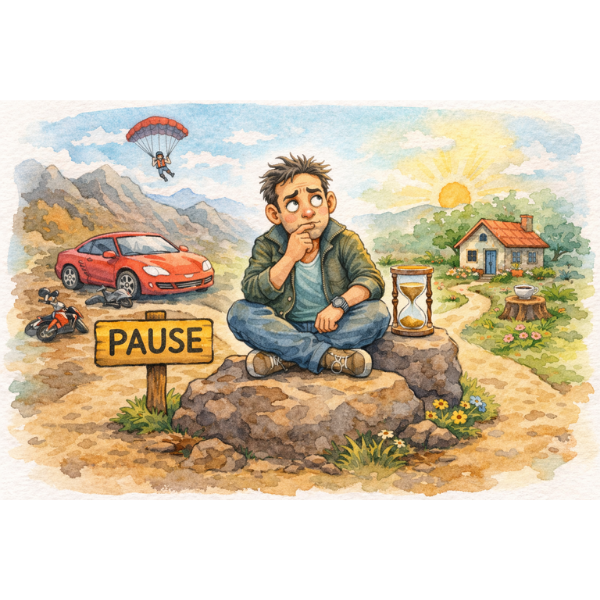
A midlife crisis is often a moment when old structures stop working, but new ones aren’t visible yet. Acting too quickly fills that gap with noise. It creates motion without direction.
Pausing doesn’t mean freezing.
It means creating space between impulse and action.
In that space, patterns become visible:
What you’re actually reacting to?
What you’ve been tolerating for too long?
What no longer fits, even if it once did?
Without that pause, experimentation tends to repeat the same logic in a new form. New job, same dissatisfaction. New relationship, same imbalance. Different surface, identical structure.
A pause allows you to experiment from clarity, not urgency.
Midlife isn’t asking you to become someone else overnight.
It’s asking you to stop pretending that everything still works.
Sometimes the most radical move is to wait — and watch carefully.